
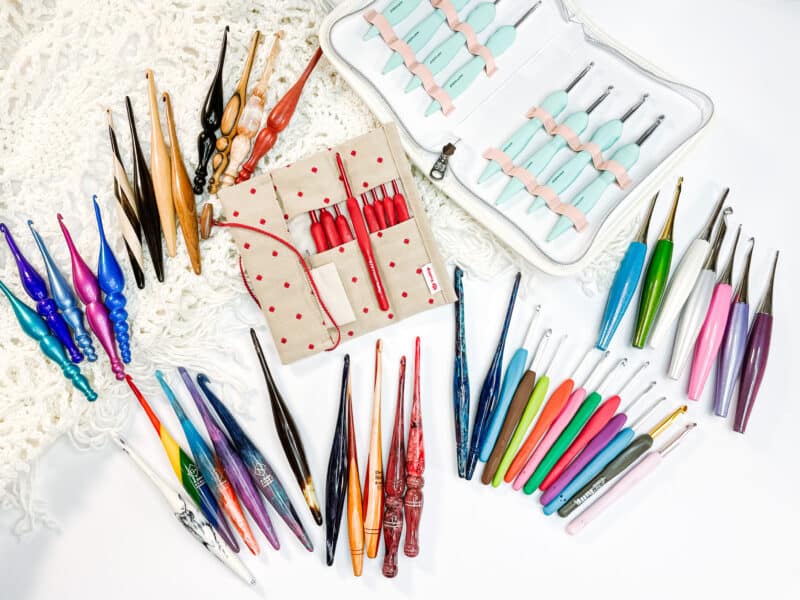
I have a drawer in my Florida studio that I am embarrassed to show you. It is roughly 40 crochet hooks deep, with at least seven 5.0mm hooks alone, because for years I kept thinking the next one would be “the one.” Some are still in regular rotation. A handful went straight to the back of the drawer after one project. After 15+ years of designing patterns and testing hooks against every weight of yarn I can get my hands on, I finally have strong opinions about which ones a beginner should actually buy first, and which ones to skip until you know what your hand prefers.
This post is the honest version. The “I have spent my own money on these and here is what I actually reach for” version. We will cover hook anatomy in a minute, but first, let me tell you what I would buy if I were starting over today with $20 in my pocket.
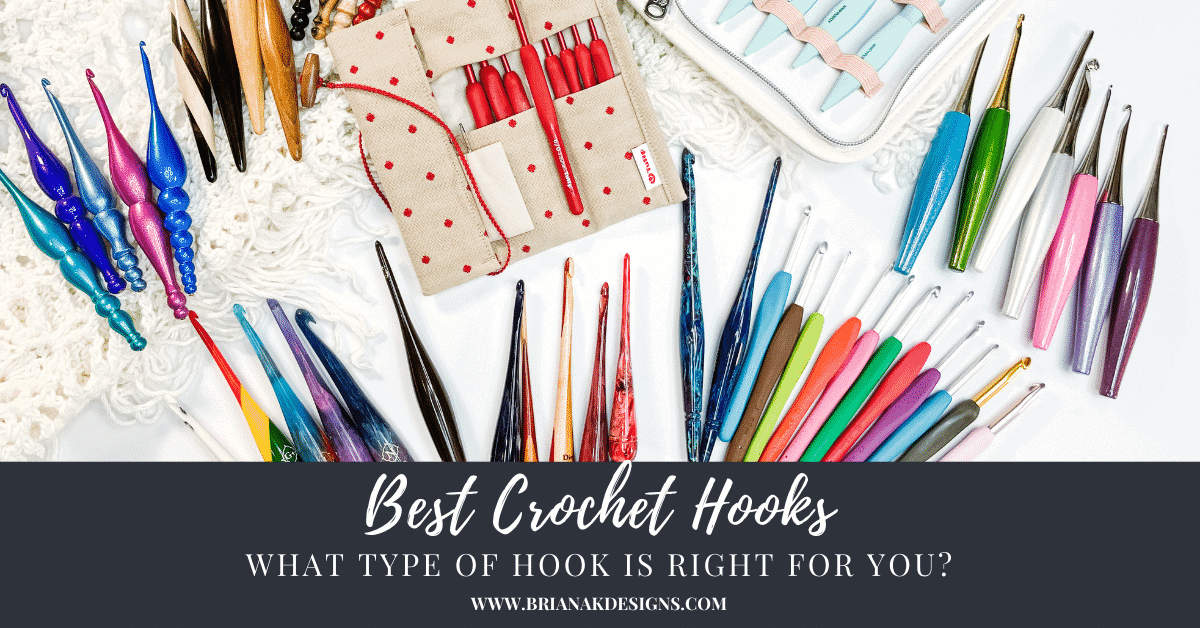
You and your best crochet friend might have totally different favorites. It’s kinda like food, we all have our likes. And if you are a wine drinker, think of it as different wines go with different foods. Same for hooks! Different hooks can pair with different yarns. It’s all about tasting and sampling everything.
Disclosure: This post contains affiliate links. Please read my disclosure for more info.
My Current Favorite: Heart Hook Home Hooks
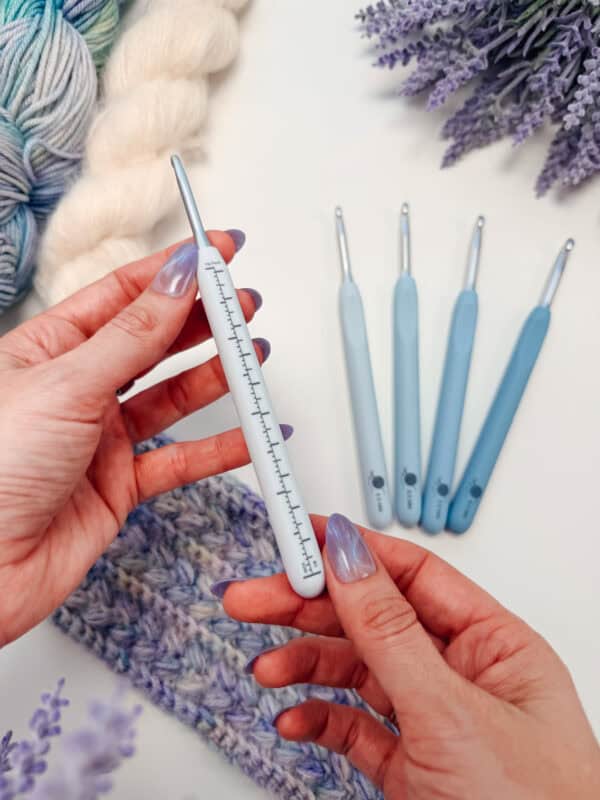
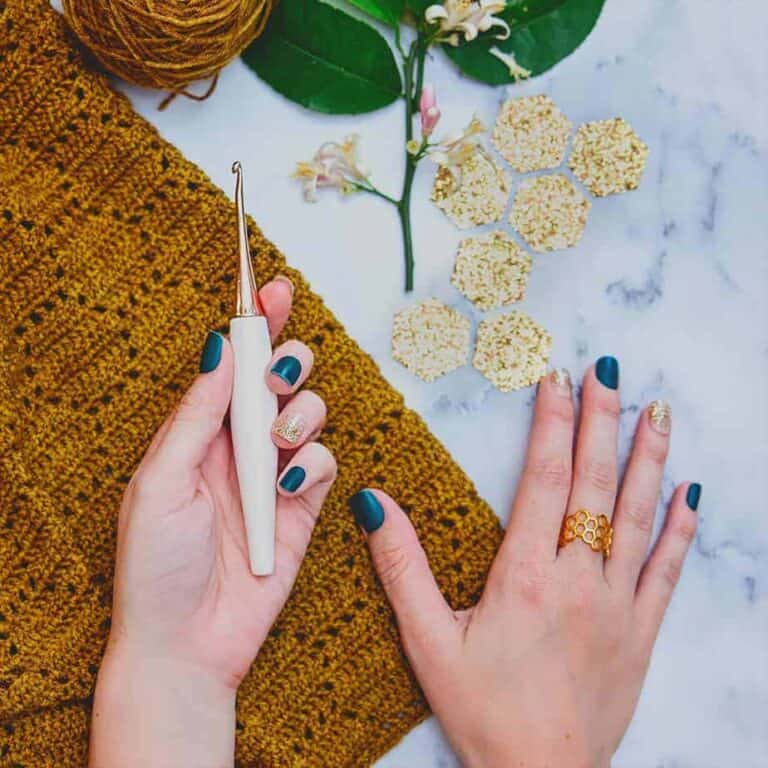
Ashlea from Heart Hook Home is a friend of mine, and when she told me she was designing her own hook, I was genuinely excited for her. This isn’t a big-box product. It’s a hook designed by a crocheter who actually uses one, for crocheters who know exactly what they want from a tool.
The detail that gets me every time: there’s a built-in ruler right on the hook. If you’re someone who’s always digging around for a tape measure mid-project just to check your gauge, this solves that problem quietly and completely. Two tools, one hook, no fuss.
If you’re going to treat yourself to a new hook, this is the one I’d point you toward. You get a well-made tool while supporting a woman-owned small business.
My Top Pick for Beginners (and Why)
If you want one answer before we get into all the details, here it is: the Crochet.com Dots Hooks.
They’re not the most expensive hook on this list, and that’s actually the point. When you’re just starting out, you don’t need to invest in a full luxury set before you even know what size you’ll use most. The Dot hooks give you a comfortable, well-made hook at a price that makes sense for someone who’s still figuring things out.
The aluminum head is smooth and moves through yarn without catching or splitting fibers, which matters more than you’d think when you’re still building your rhythm. Each hook is color-coded by size and stamped with the millimeter measurement, so you’re never digging around trying to figure out which one you grabbed. There’s also a small hole at the end of the handle that’s perfect for clipping a stitch marker or keeping your hooks together on a ring — a small detail, but a thoughtful one.
The handle has a slightly triangular thumb pad that supports a natural grip, whether you hold your hook like a pencil or like a knife. It’s comfortable enough for a long session without being so bulky that it feels awkward in smaller hands.
Start with one hook in a 5mm size to try it before committing to the full set. Make a project with it, see how it feels, and go from there.
Best Wooden Crochet Hooks (Smooth & Warm)
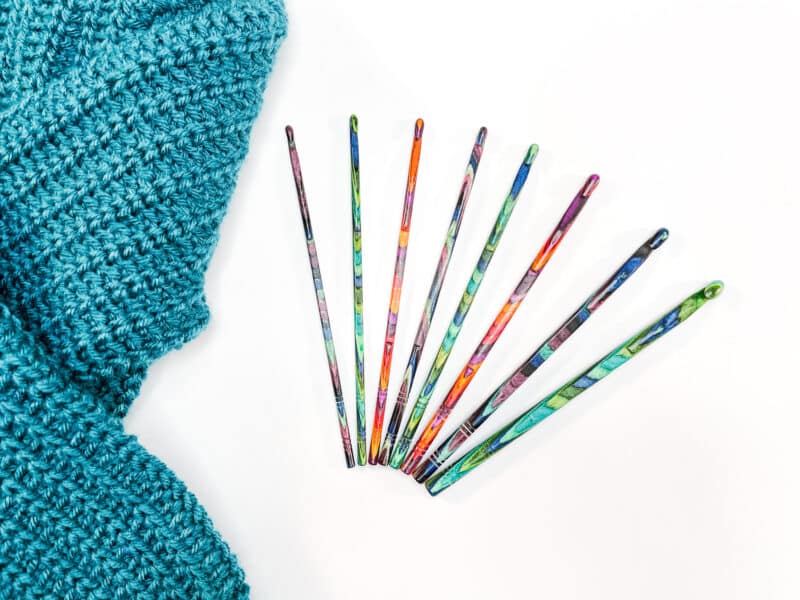
The Mosaic Wood Crochet Hook Set gives you the same strong and smooth layers of laminated birch in every color you could want.
Set price is $47.29 ($5.91 per hook)
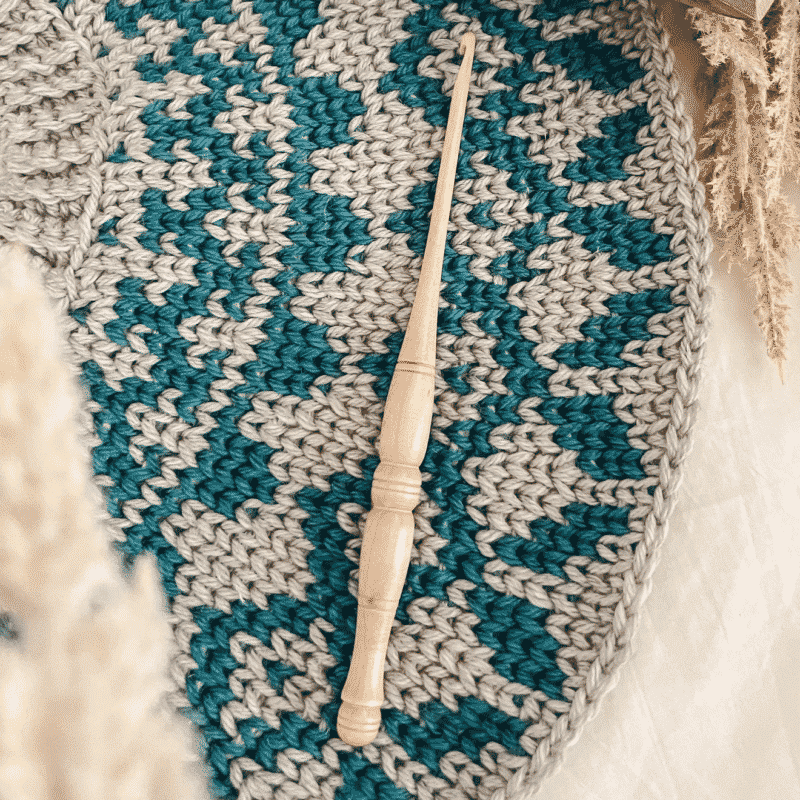
These hooks are available on Amazon for a pretty incredible price. They are crafted from maple wood and are very lightweight. The shaping of the wood helps keep your hands comfortable.
Hooks Start At $8.85
Best Ergonomic Crochet Hooks (Metal Heads, Cushioned Grips)
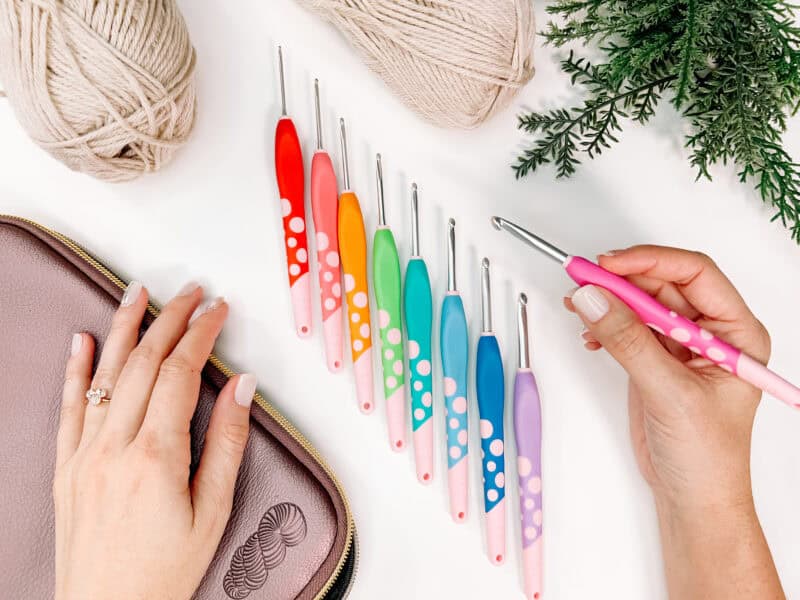
I use these a LOT! Playful and comfortable, these Dot hooks will keep you crocheting for hours. Each hook is marked with the mm information and color-coded by size. Dot hooks also include a unique hole at the end, perfect for holding stitch markers or keeping your hooks together.
Hook set starts at $29.99
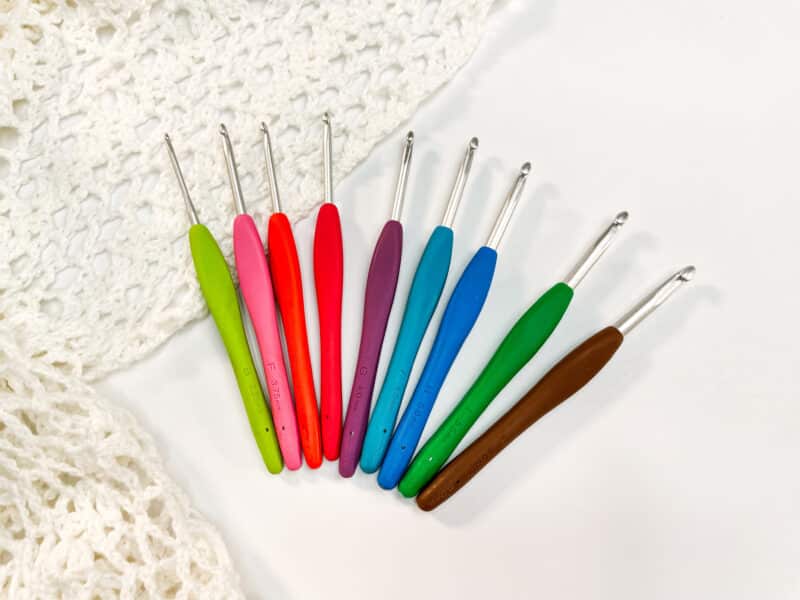
One of my favorite starter sets. I love the metal on these hooks, and the rubber helps keep a good grip. Clover also offers plastic-headed, larger sizes available as single hooks, and a Steel Crochet Hook Set (sizes from 0.60mm to 1.75mm).
Hooks start At $10.75/$93.95 for a set
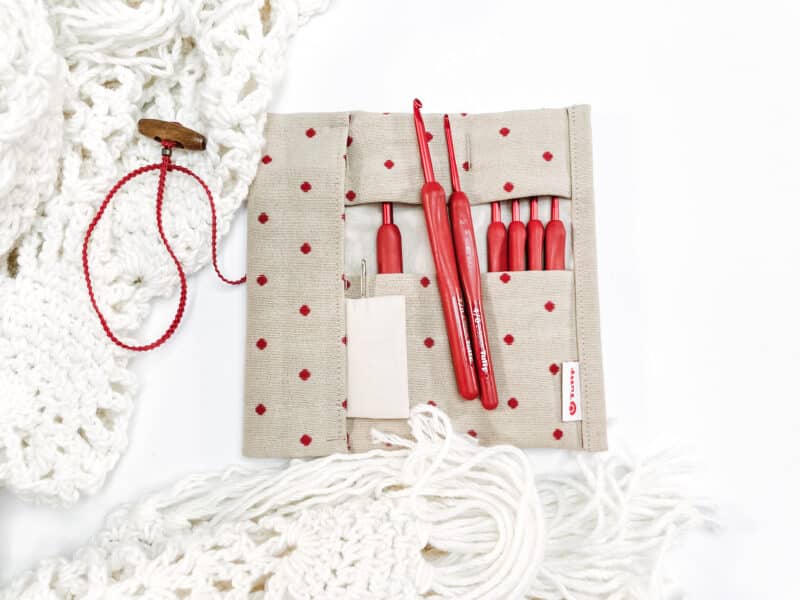
With signature soft comfort-grip handles, these hooks allow for greater accuracy in your work and increased comfort, resulting in longer, more fulfilling stitch sessions.
Hooks start at $10.98/$99.00+ for set
Best Resin Crochet Hooks

Best Ophire Hooks
The smooth, rounded head and tapered throat allow the yarn to glide easily and prevent fiber splitting.
Hooks start at $20.00
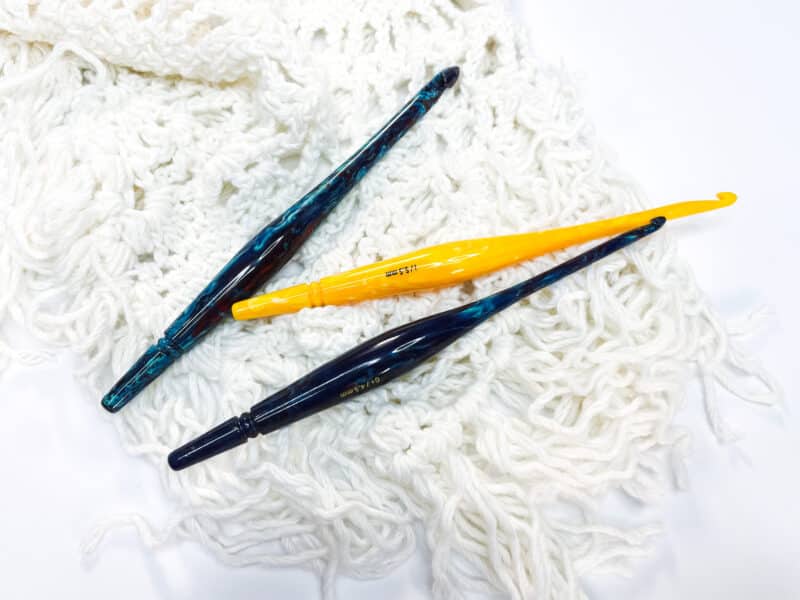
The resin crochet is 7 inches long and very comfortable to hold, with a smooth, polished finish.
Hook starts at $12.85
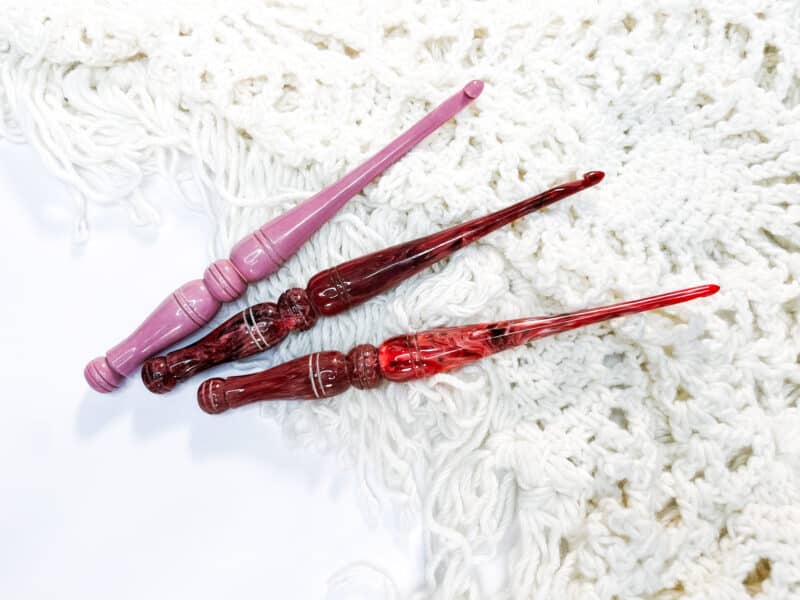
Each resin crochet hook is finely made, with a smooth, polished finish that lets you crochet effortlessly; it also makes a great gift for someone who loves crocheting.
Hook starts at $12.85
One Handle, Every Size: Interchangeable Hook Sets I’m Into
I’ll be honest — I didn’t think much about interchangeable hooks until I actually tried them, and now I kind of can’t stop thinking about them. The concept is simple: one handle, a set of hook heads that screw or snap in, and suddenly you’re not digging through a case looking for the right size. You just swap the head and keep going.
For anyone who crochets across many different projects and yarn weights, this is a genuinely smart way to build your collection. Instead of buying twelve separate hooks, you buy one handle you love and a set of heads to go with it. It’s also a great travel setup — one compact case covers every size you’d need.
Here are two sets I’ve been playing around with:
Svartur Interchangeable Crochet Hook Set — This one comes with 12 aluminum hook heads ranging from 3mm to 10mm, which covers pretty much everything from fine amigurumi work to chunky blankets. The ergonomic handle has a soft-touch, brushed aluminum grip that’s designed for long sessions, and the seamless connection between handle and hook head means yarn glides through without catching at the joint, which was honestly my biggest concern before I tried it. It comes in a zippered case that keeps everything organized and travel-ready. If you deal with hand fatigue or crocheting for long stretches is your thing, the ergonomic handle on this one is worth it. They’re on the heavier side, but I didn’t mind that.
Check out my video here: YouTube
Mdoker Interchangeable Crochet Hook Set — This set goes a different direction with a wooden handle and aluminum hook heads, and if you’ve ever wanted the warmth of a wood hook without committing to an all-wood set, this is a nice way to get there. It covers 9 sizes from 3.5mm to 8mm, which hit all the most-used everyday sizes. The wooden handle has a natural grip that slows things down just slightly compared to rubber or silicone, which can actually be a good thing if you’re working with slippery yarn that tends to slide off a smooth hook. It comes in an embroidered storage pouch that’s genuinely pretty — the kind of thing that makes it a nice gift too. I made a quick video showing the difference between a budget hook and a luxury hook… wait ’til the end!
The main difference between these two sets of interchangeables comes down to handle feel and size range. If you want maximum coverage and a gorgeous brushed-aluminum feel, go with Svartur. If you love the feel of wood in your hand and are working mostly in that 3.5mm to 8mm sweet spot, the Mdoker is a lovely option. Either way, if you haven’t tried an interchangeable set yet, it’s worth the experiment.
Pretty Plastic Hooks: Because Sometimes You Just Want Something Cute
Not every hook purchase needs a practical justification. Sometimes you see something colorful and pretty, and you just buy it. I did exactly that with these two, and I’m not sorry about it.
That said, they’re actually good hooks. So here’s the honest rundown.
Coopay Inline Crochet Hook Set — These are what got me. The see-through plastic handles come in macaron pastel colors, and they’re just genuinely pretty to look at sitting on your desk. But beyond the aesthetic, they’re inline hooks, which means a deeper groove that grips yarn more cleanly — something I don’t always expect from a plastic hook at this price point. The handles have a textured grip pattern that keeps them from slipping even when your hands are a little warm, which is a detail I appreciated more than I expected to. They cover 2.5mm through 6mm, so they’re well-suited for lighter-weight projects, amigurumi, and anything in the fine-to-medium yarn range. If you’re someone who learned on inline hooks and has been looking for a fun everyday set, these are an easy yes.
Of course, I reviewed them! Watch the video here!
BsHooker Inline Crochet Hook — The clear acrylic handle on this one has a different look entirely — more sleek and polished than the Coopay, almost like holding a piece of sea glass. The hook head is aluminum with an inline design and a smooth finish that actually performs well, and the extra length gives you a little more handle to hold onto, which some crocheters prefer, especially for longer sessions. It comes in sizes 3mm through 8mm individually, so you can grab just the size you need rather than committing to a full set. The hook you picked up because it looked good does its job well.
Are these my go-to hooks for a big project? Probably not. Are they sitting on my desk right now because they make me happy to look at them? Absolutely. Sometimes that’s reason enough.
Best Crochet Hooks for Arthritis and Hand Pain
If your hands ache after crocheting for a while, the hook you’re using might be making it worse. Bare metal handles, thin shafts, and hooks that don’t fit your natural grip all create more tension in your fingers and wrist than you realize. The good news is that switching to the right hook makes a genuine difference, and you don’t have to spend a lot to feel it.
Here’s what to look for and what I’d actually recommend:
Grip thickness. A wider handle means your fingers don’t have to squeeze as hard to maintain control. Thin aluminum handles, the kind that come in basic sets, are the worst offenders for hand strain. Look for something with a cushioned grip section wide enough that your hand can relax around it rather than pinch it.
Cushion material. Soft rubber and silicone grips absorb the small vibrations that travel up into your joints when the hook catches on yarn. Hard plastic doesn’t do this. The difference is subtle stitch to stitch, but over an hour of crocheting, it adds up.
Hook length and weight. Longer hooks give you more surface area to hold, which distributes pressure across more of your hand. Weight is personal, though. Some crocheters with hand pain find a slightly weighted hook steadying. Others find it exhausting. If you’re unsure, start lighter and work up.
My three recommendations:
Prym Ergonomics — Prym’s ergonomic hooks have a softgrip handle with a distinctive triangular thumb rest that naturally positions your hand without forcing it. That guided positioning is especially helpful when your grip tends to shift or tighten up without you noticing. The handle is chunky enough to hold comfortably without squeezing, and the aluminum head is smooth and snag-free.
Boye Ergonomic — The Boye ergonomic handle is one of the widest and chunkiest on the market, which is exactly why crocheters with arthritis specifically seek it out. If grip thickness is your primary concern, this one delivers. The handle shape is uniquely curved and especially comfortable for a knife-grip hold. One honest note: some hooks in the set may have slightly less-smooth metal than premium options, but for hand comfort and price, it’s hard to argue with.
Tulip Etimo Rose — The Etimo Rose is Tulip’s softer-grip version of their already excellent Etimo hook. The cushion on the handle is noticeably plusher than the standard Etimo, and the hook head is as smooth as anything on the market, which means less resistance and less effort per stitch. For crocheters who want a lighter hook with maximum softness in the handle, this is the one.
A few technique notes that help as much as the hook does:
Don’t death-grip your hook. Most crocheters hold on tighter than they need to, especially when they’re focused. If you can feel your knuckles tightening, loosen up. The hook does the work, not your grip.
Take breaks. Seriously. Set a timer for 25 or 30 minutes and put the hook down for five. Repetitive strain builds up faster than it feels like it’s building.
If one hand position starts to ache, temporarily switch your grip style. Pencil-grip crocheters can switch to a knife grip for a few rows, and vice versa. It’s not perfect form, but it moves the strain to different muscles and gives you more time before you have to stop.
Best Crochet Hooks for Amigurumi and Tight Tension Projects
Amigurumi and other tight tension projects are their own category when it comes to hook choice. You’re working with small hooks, small yarn, and intentionally tight stitches specifically to keep stuffing from showing through. The hook that’s perfect for a chunky blanket is completely wrong for a 2.5mm amigurumi round.
Here’s what matters most for this type of work:
Inline over tapered. When you’re pushing a hook into a tight stitch over and over, an inline head gives you more precision and control. The sharper, more defined groove catches the yarn cleanly without you having to wiggle the hook around to find it. For regular projects, the difference between inline and tapered is mostly a matter of personal preference. For amigurumi, inline is the practical choice.
Narrow shaft. A shaft that flares out quickly after the throat will drag against tight stitches and slow you down. You want a hook where the transition from throat to shaft is gradual and smooth, so it slides in and back out without resistance.
Smooth metal, no exceptions. Any roughness on the hook head that you might not notice in a loose blanket stitch will constantly catch and split fine yarn. This is where hook quality actually shows up in your finished work.
My recommendations:
Clover Amour in 2.0mm to 3.5mm — The Clover Amour’s aluminum head is consistently smooth across every size, including the small ones, where quality control tends to slip on cheaper hooks. The tapered head is gentle enough on fine yarn that it doesn’t split fibers, even at tight tension, and the cushioned handle keeps your hand comfortable through long amigurumi sessions that would otherwise cramp your fingers with a bare metal hook. This is my first recommendation for anyone getting into amigurumi.
Tulip Etimo Small Sizes — If you want the smoothest possible hook head in the small size range, the Etimo is the answer. The steel head on these hooks offers almost no resistance, which means less effort when pushing into each tight stitch and less fatigue over a long project. The cushioned handle holds up in small sizes too, which isn’t always the case with ergonomic hooks, which are often designed with larger sizes in mind. These are a genuine upgrade if you’re doing a lot of amigurumi work and want to feel the difference.
One honest note: if you’re brand new to amigurumi, start with the Clover Amour before investing in the Etimo. Get comfortable with the stitch style first. The Etimo is worth it once you know amigurumi is something you’ll keep doing.
Crochet Hooks I Don’t Reach For (and Why)
I debated including this section because I genuinely don’t love discouraging anyone from trying something. Hook preference is personal, and what doesn’t work for me might work great for you. But I also get asked constantly which hooks aren’t worth it, and I think an honest answer is more useful than a list of everything being great.
So here are a few I’ve tried and set aside, and why.
Lite-Up Counting Hooks
I wanted to love these. The idea is genuinely clever — a hook with a built-in light and a stitch counter right in the handle. On paper, that solves two real problems. In practice, the handle is bulky in a way that doesn’t feel ergonomic so much as just large, and the light, while fun, isn’t something I find myself actually needing once I’m in a rhythm. The metal on the hooks I tried wasn’t as smooth as I’d like, which is the thing I notice most because it affects every single stitch. If the counter feature is something you know you’d actually use, they might be worth trying. For me, they collect dust.
Basic Bare Metal Sets (No Handle)
This one isn’t a brand callout; it’s a category. The classic full-aluminum hooks with no grip, no handle, nothing but metal from tip to end. I know a lot of crocheters learned on these and love them, and I genuinely respect that. But after crocheting with a cushioned handle, going back to bare metal for any length of time quickly reminds me why I switched. Your hand does a lot more work to maintain grip, and over a long session, that shows up as fatigue and soreness. If you’re just starting out, spend a few extra dollars and skip this category entirely.
Inline vs Tapered Hooks (The Single Most Important Choice)
Here we go for the best part, the best crochet hooks. When it comes to finding which you like best, it’s a process of trial and error. Whenever working with a new hook, give it a chance. It will always feel odd at first, but complete at least one project with it before forming an opinion.
And if you are looking for a new hobby, I recommend collecting a variety of different hooks. I enjoy it myself, lol.
The first thing we must talk about is what each part of the hook is labeled and how they may differ from brand to brand. Keep on reading for my list of favorite hooks and pricing.
Crochet Hook Anatomy (Why It Matters for Your Stitches)
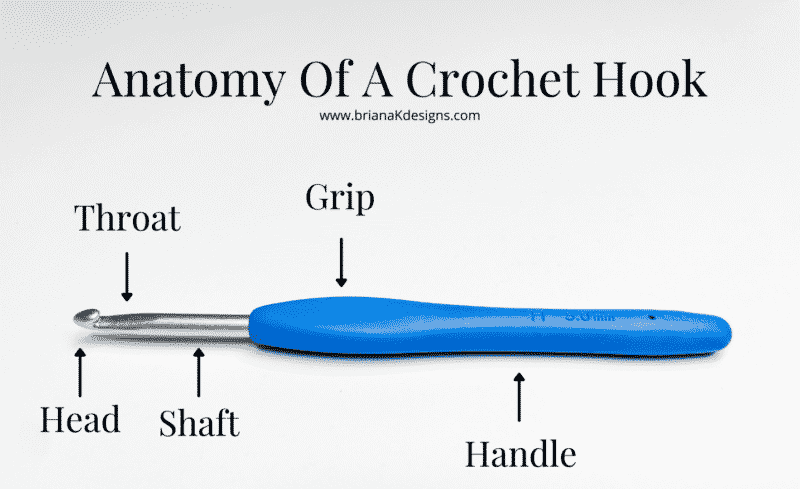
The Head, Throat, & Shaft Of The Crochet Hook
For me, the head of the hook is just as important as the grip, possibly more important. There are two main types of hook heads: inline or tapered. When it comes to choosing between an inline and a tapered hook, it really comes down to preference.
An inline hook has a deeper space between the hook and the shaft. And it can have a sharper point, which I find helpful for working the split single crochet stitch when doing colorwork. Because the throat has a steeper taper, it tends to be thinner. So, even when you have the same crochet hook sizes between two brands, these shapes differ.
A tapered hook will look curvier, without sharp lines. This is helpful for reducing splitting yarn that isn’t plied tightly or is very textured.
The two entry-level hooks most talked about are Susan Bates (inline) and Boye (tapered). Since these basic metal hooks are inexpensive, it’s great to try each one and see which type of crochet hook head you prefer.
Knife Grip vs Pencil Grip (And Which Hook Suits Each)
When it comes to the handle, this is where we start to see lots and lots of variations and styles. From basic to ergonomic, with different types of materials, including plastic, wood, steel, and resin. We will go over each type, and even the combinations, below.
Crochet Hook Size Chart (US vs UK vs Metric)
How are hook sizes labeled? It can often feel confusing for new crocheters to see numbers and letters on a hook. What does it mean? And what’s even more confusing is that crochet hook size labels can vary by region.
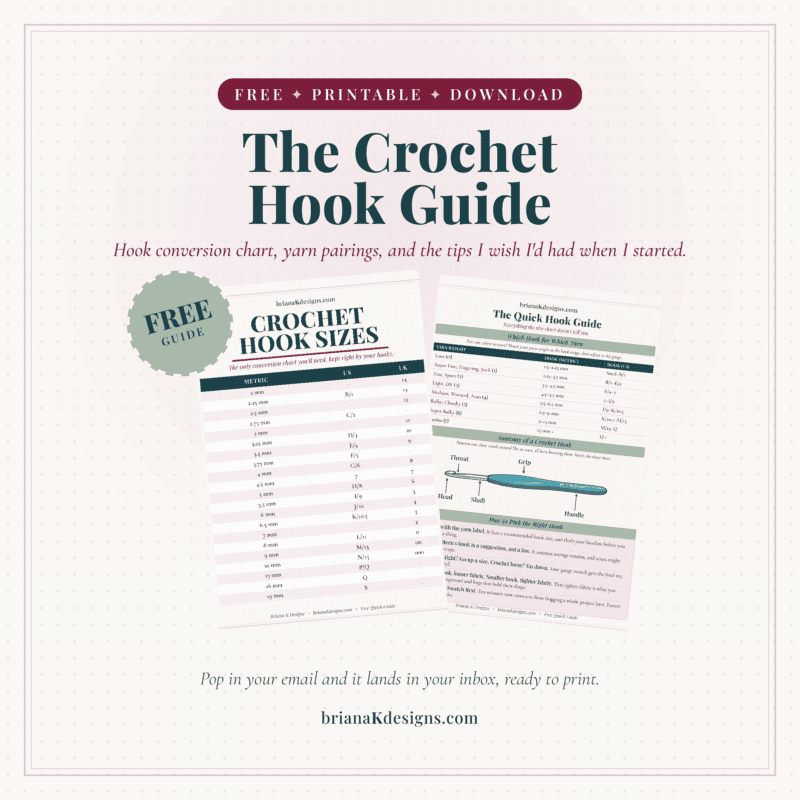
Listen, if I had my way, we would all get on the same page and use only one labeling system, but I feel we have passed the point of no return. So instead, I’ve made this chart to help you out. Whenever in doubt, go by the millimeters; that’s just math and fact.
The way crochet hook sizes are labeled in the United States is different from that in the United Kingdom. This crochet hook size chart will come in handy if you ever have doubts. Be sure to pin it and bookmark this post.
Get the FREE Download
Conversion chart, yarn pairings, and the tips I wish I’d had when I started!
Crochet Hook FAQs (Beginner Edition)
What size crochet hook should a beginner start with?
A 5mm hook, also called a US size H-8, is what I’d tell almost every beginner to start with. It pairs perfectly with worsted-weight yarn, the most widely available weight, and the one most beginner patterns are written for. At 5mm, the stitches are large enough to see clearly while you’re learning, the hook is easy to hold and control, and worsted yarn has enough body that it doesn’t slip off the hook the way thinner yarn can. I’d recommend picking up a single 5mm hook before buying a full set, making one project with it, and getting comfortable before you invest in a whole range of sizes. Once you know you love crocheting, the set makes sense. Before that, one good hook is enough.
Does hook material affect tension?
It does, more than most beginners expect. The material of the hook shaft affects how quickly yarn slides over it, which in turn affects how loose or tight your stitches sit. A very smooth hook, such as one with a polished aluminum or steel head, allows the yarn to glide easily and can result in slightly looser stitches. A hook with more grip, such as wood or certain resins, slows the yarn a little and can result in slightly tighter stitches. Neither is wrong, but if you switch hook materials mid-project, you might notice your gauge shifting. For that reason, I’d recommend sticking with the same hook throughout any project where sizing matters, such as a garment or a fitted hat. For blankets and bags where a stitch or two of difference doesn’t make much difference, it’s not something you need to worry about.
Are ergonomic crochet hooks worth it?
For most crocheters, yes, and the longer you crochet, the more worth it they become. A basic aluminum hook with no handle works fine in short bursts, but after 30 to 45 minutes, your fingers start doing a lot of work just to maintain grip. An ergonomic handle with a soft rubber or cushioned grip lets your hand relax, reducing fatigue and letting you crochet for longer before you feel it. If you’re brand new and still deciding whether crochet is going to stick, starting with an inexpensive basic hook is completely reasonable. But once you know you’re in it, an ergonomic set is one of those upgrades you’ll wonder how you went without. Your future hands will thank your current hands for making the switch.
How long do crochet hooks last?
A good-quality crochet hook can last for years, sometimes decades, with basic care. Metal and aluminum hooks are essentially indestructible under normal use. Wood hooks can develop small cracks over time if they’re stored loosely in a bag where they knock against hard surfaces, so a hook case or roll is worth having. Resin hooks are durable but can chip or crack if dropped on hard floors, which is the main thing to watch for. The part that tends to wear out first on ergonomic hooks is the rubber or silicone grip, which can sometimes peel or compress with heavy use, but even then, the hook itself remains functional. I have metal hooks that are well over five years old and still perform exactly the same as the day I got them.
What is the difference between US and UK crochet hook sizes?
The sizing systems use different letters and numbers to describe the same physical hook sizes, which is genuinely confusing the first time you run into it. The good news is that millimeters are universal. Every hook manufactured anywhere in the world has a millimeter size stamped on it, and that number means the same thing regardless of where the hook or the pattern came from. When you’re in doubt, ignore the letter or number and go by millimeters. The chart earlier in this post provides a full US-to-UK conversion breakdown that you can bookmark and return to whenever you need it. If you’re following a UK pattern and a US one at the same time, just check the mm on both, and you’re sorted.
Should I buy a hook set or individual hooks?
Start with one or two individual hooks, then buy a set once you know you like the brand. Here’s why: hook preference is personal, and what feels right in someone else’s hand might not feel right in yours. Spending $60 on a full set before you’ve crocheted a single project with that hook is a gamble. Grab a single hook in the 5mm size you’ll use most, make something with it, and pay attention to how your hand feels after an hour. If you like it, the set is a great investment because you’ll eventually need multiple sizes anyway. If something feels off, you’ve only spent $7 to $10 figuring that out instead of $60. Once you commit to a set, buying one brand across the full size range is more practical than mixing brands, since handle shape and hook feel vary enough between brands that switching back and forth mid-project can feel awkward.
Why are some crochet hooks so expensive?
A few things genuinely drive up the price, and a few are just branding. On the legitimate side, the quality of the metal finish on the hook head makes a real difference. A hook head with a smooth, polished finish costs more to produce than one that’s just stamped out and left rough, and that smoothness shows up in every single stitch you make. Ergonomic handle engineering also adds cost, specifically the research into grip shape, cushion material, and hand positioning that goes into a well-designed handle. Hand-turned wood hooks and resin hooks require more labor per unit than mass-produced aluminum hooks. On the branding side, some hooks are expensive because they’ve built a reputation and an aesthetic around the product, and you’re partly paying for that. My honest take: you don’t need to spend a lot to get a great hook. The Clover Amour sits at $7 to $10 and outperforms hooks that cost three or four times more in day-to-day use. Spend more if you want to, but know that the quality ceiling for practical crocheting is lower than the price ceiling.
Find Your Hook and Go Make Something
Here’s the truth about crochet hooks: there’s no single right answer, and anyone who tells you otherwise is trying to sell you a very specific hook. I’ve said this before, and I’ll keep saying it because I really believe it — choosing a hook is like pairing wine with a meal. You’re not always going to reach for the same hook on every project. You’re going to pair whatever hook works best with the yarn’s fiber. A smooth aluminum head for cotton. A wood hook for something slippery. An ergonomic handle for a big blanket that’s going to take weeks. It’s a relationship between the tool and the material, and getting that pairing right is part of the craft.
The best hook is the one that feels good in your hand, works with the yarn you love, and doesn’t make your wrist ache after an hour. That’s it.
If you’re just starting out, grab a Crochet.com Dot Hook in a 5mm and make something. If you’ve been crocheting for years and your hands are tired, try the Etimo Rose or the Boye Ergonomic and see if it changes your experience. If you want something that’s genuinely special and comes from someone who actually crochets, my friend Ashlea’s Heart Hook Home hooks are the real deal — built-in ruler and all.
And if you end up with a drawer full of hooks you’ve collected over the years because you kept wanting to try just one more? Honestly, same. There are worse hobbies.
I’d love to know which hook is your favorite or which one you’re eyeing next. Drop it in the comments below — I read every single one.
See These Hooks in Action: Patterns to Try
The best way to figure out which hook is really yours is to make something with it. Here are a few of my patterns that are great for testing out a new hook — I’ve included the hook size I used so you can grab the right one before you start.
How to Crochet the Wheat Stitch™ — This is the textured stitch I designed and probably use more than anything else in my studio. Work up a swatch with a 5.0mm hook, and you’ll get a feel for how your hook handles a more structured, repeating stitch pattern. Great for testing inline vs. tapered too.
Willow Mesh Crochet Market Bag — I made this one with my Heart Hook Home hook in a 5.0 and a 5.5 mm. The open-mesh construction is a good test of how smoothly your hook glides through larger loops without snagging.
Boho Pineapple Wrap — This one is a great example of the hook-and-yarn pairing I’m always talking about. It uses DK-weight yarn with a 6.5mm hook, which is larger than you’d expect for a thinner yarn. That combination creates the airy, open drape that makes this wrap work. If you’ve ever wondered what happens when you size up your hook intentionally, this pattern is a perfect place to experiment with it.
Petal Loop Blanket — This is the other end of the spectrum. Two strands of worsted-weight yarn held together, and a 10mm hook make for a chunky, fast-working project that’s incredibly satisfying to crochet. If you’ve been eyeing a larger hook and want a reason to try one, this blanket is it. It’s also a good reminder that your 5mm everyday hook and your 10mm blanket hook are both doing the same job — just on very different scales.
Psst: my crochet pattern app keeps your row count and your place for you, plus four free crochet tools. No subscription required.
Hook down? Not so fast…
I’d Love to See Yours!
You made something beautiful. Here’s how to keep it, show it off, and inspire the next maker.

What should you make next?
Keep the hook movingReaders Are Loving
 Stacked Single Stitch
 Extended HDC Stitch
 No More Chain Twists
 Crochet an I-Cord